How to Find and Optimize Striking Distance Keywords to Improve SEO Rankings
Improving search engine rankings doesn’t always require creating new content or targeting highly competitive keywords. Sometimes, the best opportunities are already hidden within your existing website.
This is where striking distance keywords come into play.
These are search queries for which your website already appears in Google search results but hasn’t yet secured a first-page position or the visibility you want. With the right optimization strategy, you may be able to improve existing rankings, attract more organic traffic, and make better use of the content you’ve already published.
For website owners, bloggers, and digital marketers, identifying these opportunities can be an effective way to strengthen an SEO strategy without starting from scratch.
In this guide, you’ll learn what striking distance keywords are, how to find them using Google Search Console, how to prioritize the best opportunities, and how content optimization, internal linking, and quality backlinks can support better search performance.
What Are Striking Distance Keywords?
Striking distance keywords are search queries for which a website already ranks relatively close to the top of Google’s search results but hasn’t reached its desired position.
SEO professionals commonly use the term for keywords ranking between positions 11 and 30. However, the exact range varies by SEO tool and strategy. Some professionals also target keywords ranking within the first ten results when they want to move them into the top three positions.
For example, imagine you have published a blog about white-hat link building. Google may already recognize your article as relevant to searches related to the topic, but the page appears on the second page of search results.
Rather than publishing another article about the same subject, you could investigate why the existing page isn’t performing better and identify opportunities to improve it.
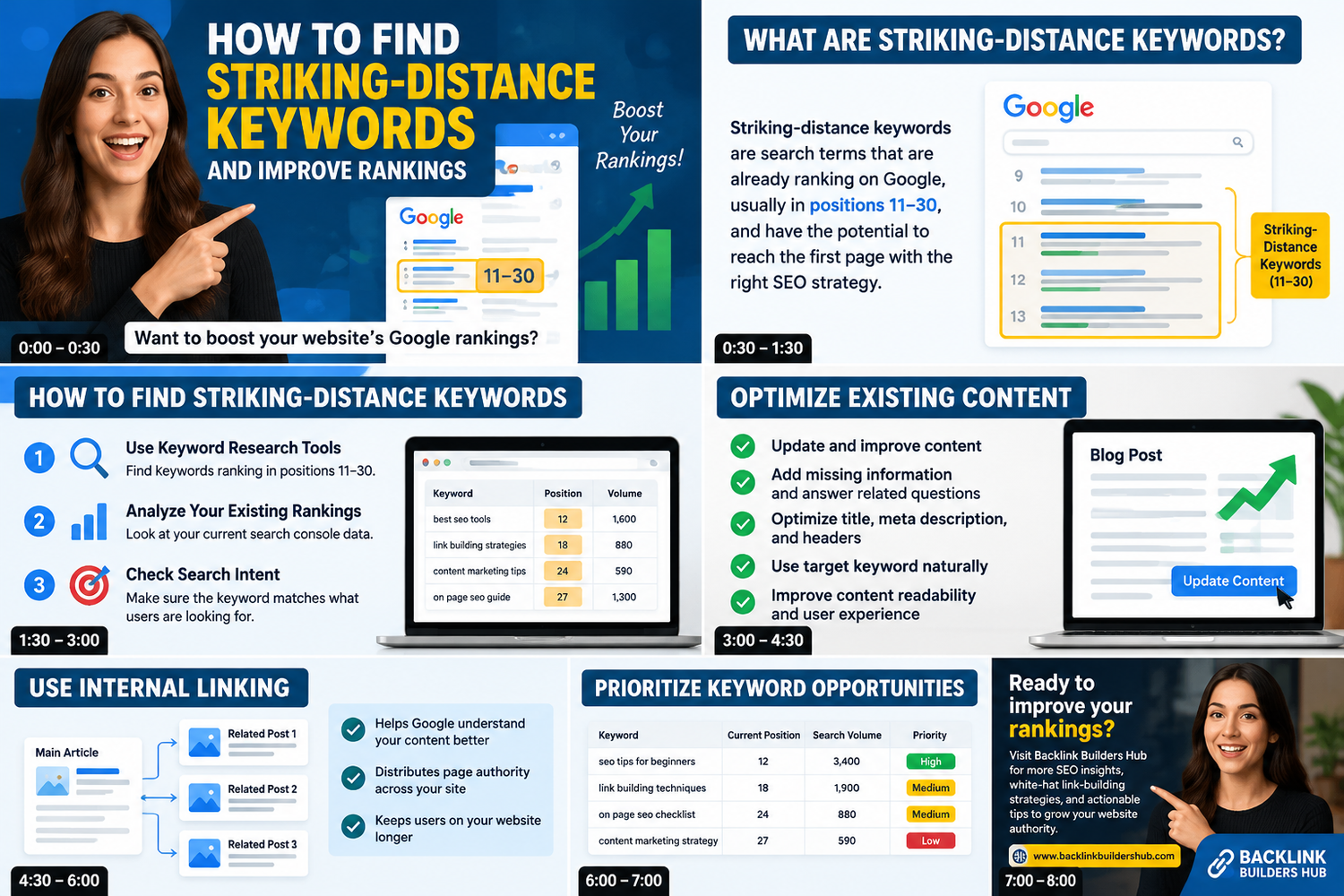
These might include:
- Updating outdated information.
- Answering questions your audience still has.
- Improving headings and on-page SEO.
- Adding relevant internal links.
- Earning quality backlinks from relevant websites.
The goal is to improve a page that already has some search visibility rather than building a completely new page without existing ranking signals.
Why Are Striking Distance Keywords Important for SEO?
Striking distance keywords matter because they help you identify opportunities based on your website’s actual search performance.
Instead of guessing which topics might bring traffic, you can use existing ranking data to determine where your optimization efforts may have the greatest impact.
1. Improve Existing Rankings
A page that already appears in search results has demonstrated some relevance to a particular query.
Although this doesn’t guarantee that the page will rank higher, it gives you a useful starting point. You can examine the content, compare it with competing pages, and address any weaknesses that might be limiting its performance.
2. Make Better Use of Existing Content
Creating new content takes research, writing, editing, and ongoing maintenance.
Optimizing an existing article may be more efficient when that article already targets the right search intent and covers the relevant topic.
For example, if your guide to backlink building ranks near the first page for several related queries, improving its examples, explanations, internal links, and content structure may be more useful than publishing another article covering the same ground.
3. Identify Opportunities for Organic Traffic Growth
Search visibility and click-through rates vary according to ranking position, search intent, competition, and the features displayed on the results page.
A keyword moving from position 18 to position 8 could gain additional visibility and clicks. However, the actual result depends on whether people search for that term and whether your page satisfies their needs.
This is why you should prioritize relevant keywords with meaningful impressions and realistic opportunities for improvement rather than focusing on ranking positions alone.
4. Connect SEO Improvements With Business Goals
Not every keyword brings visitors who are likely to become customers.
For a backlink agency, a query related to professional link-building services may be more commercially valuable than a broad informational query, even if the latter receives more impressions.
Prioritizing keywords that align with your services helps you attract an audience that is more relevant to your business.
How to Find Striking Distance Keywords Using Google Search Console
You don’t necessarily need an expensive SEO subscription to begin finding striking distance keywords. Google Search Console provides useful information about the queries that already bring your website into search results.
Follow these steps to identify potential opportunities.
Step 1: Open Google Search Console
Visit Google Search Console and select your website property.
If you haven’t verified your website yet, you’ll need to complete the verification process before accessing its performance data.
Step 2: Open the Performance Report
Navigate to Performance → Search results.
You’ll see metrics such as:
- Total clicks: How many clicks your website received from Google search results.
- Total impressions: How often your website appeared in search results.
- Average CTR: The percentage of impressions that resulted in clicks.
- Average position: Your site’s average ranking position for the selected data.
Enable the metrics you need, particularly impressions, clicks, CTR, and average position.
Set the date range to the last three months or six months, depending on how much data is available. A longer period can help you identify patterns rather than reacting to short-term fluctuations.
Step 3: Examine the Queries Report
Scroll to the table and select the Queries tab.
This report shows the search terms associated with your website’s performance.
Look for queries that meet criteria such as:
- An average position between 11 and 30.
- Relevant search intent for your business.
- Consistent impressions or promising visibility.
- A ranking page that could realistically be improved.
Prioritize queries that are already close to the first page, particularly those ranking around positions 11–15, when other factors are comparable.
Remember that average position is an aggregate metric. A keyword’s actual ranking can differ across locations, devices, dates, and individual searches.
Step 4: Identify the Page Ranking for Each Keyword
Click an individual query, then open the Pages tab.
This helps you determine which URL receives impressions for that search term.
Check whether the page genuinely addresses the query. If the search is about backlink audit techniques, for example, a general article about digital marketing may not be the best page to optimize.
You should also check whether multiple pages appear for the same query. This can indicate overlapping content, although multiple ranking URLs do not automatically mean keyword cannibalization is occurring.
Step 5: Export Your Data for Analysis
Google Search Console allows you to export performance data into Google Sheets, Excel, or other supported formats.
Create a working spreadsheet with columns for:
- Search query
- Ranking page
- Average position
- Impressions
- Clicks
- CTR
- Search intent
- Optimization priority
- Actions required
This makes it easier to compare opportunities and track changes after updating your content.
How to Choose the Best Striking Distance Keywords
Finding keywords is only the beginning. The next step is deciding which ones deserve your time and resources.
1. Evaluate Search Demand
Look at impressions in Google Search Console to understand how often your website appears for a query.
You can use keyword research tools to estimate monthly search volume, but remember that third-party estimates are not the same as verified Google search volumes.
A keyword with strong search demand may offer greater traffic potential, but relevance and competition still matter.
2. Consider Current Ranking Position
A page ranking at position 12 may be a more practical optimization opportunity than one ranking at position 29, assuming both pages have similar relevance and competitive conditions.
However, position alone should not determine your decision. Investigate the quality of the current results and the changes required to compete.
3. Check Search Intent
Search intent describes what someone wants to accomplish when entering a query.
Common types include:
- Informational: Learning about a topic.
- Commercial investigation: Comparing products, providers, or solutions.
- Transactional: Taking an action, such as purchasing a service.
- Navigational: Finding a particular website or brand.
Your content should match the intent behind the query.
If people searching for “how to build backlinks” want a practical tutorial, a page that immediately pushes them toward a sales offer may not meet their expectations.
4. Assess Competition
Examine the pages already ranking above yours.
Ask yourself:
- Do they provide more comprehensive information?
- Are their examples more useful or current?
- Do they answer related questions more clearly?
- Are their pages better aligned with search intent?
- Do they have stronger, more relevant backlink profiles?
This analysis helps you identify meaningful improvements instead of simply adding more words to your article.
5. Consider Business Relevance
Prioritize keywords that support your broader goals.
For a link-building agency, relevant opportunities might include queries about guest posting, backlink audits, white-hat link building, and improving website authority.
A keyword doesn’t need to have the highest search volume to be valuable. It needs to attract the right audience and offer a realistic path toward your objectives.
How to Optimize Content for Striking Distance Keywords
Once you’ve identified your strongest opportunities, focus on improving the pages that already rank for them.
1. Improve Content Quality and Relevance
Start by reviewing the existing article.
Does it answer the primary question clearly? Is any information outdated? Are important subtopics missing? Could readers benefit from a practical example or step-by-step instructions?
Update the content where improvements genuinely help the reader.
For example, an article about backlink strategies might benefit from a section explaining how to evaluate a referring website, recognize potentially harmful link-building practices, and measure the results of an outreach campaign.
Avoid adding unnecessary paragraphs merely to increase word count.
2. Optimize Titles and Headings
Your title tag, main heading, and subheadings should communicate the page’s subject clearly.
Include the target keyword naturally where it makes sense, but don’t force the exact phrase into every heading.
For example, if the target query is “striking distance keywords,” a useful heading could be:
How to Find Striking Distance Keywords in Google Search Console
This is descriptive, relevant, and directly connected to what the reader wants to learn.
3. Improve the Meta Description
A compelling meta description can help communicate the value of your page to potential visitors.
Explain what readers will learn and why the information is useful. Avoid exaggerated promises or guarantees.
Google may generate a different search snippet based on the query, so a well-written meta description doesn’t guarantee that your exact text will appear or directly improve rankings.
4. Add Relevant Internal Links
Internal links connect related pages within your website and help readers discover useful resources.
Suppose you have an article about striking distance keywords and another about white-hat link building. A contextual link between them may help readers understand how link acquisition fits into a broader SEO strategy.
For best results:
- Link from relevant existing articles.
- Use descriptive anchor text.
- Ensure the destination provides additional value.
- Avoid adding links where they don’t naturally fit.
You can also link to relevant service pages when they provide a useful next step for the reader.
5. Strengthen the User Experience
Make sure your article is easy to navigate on desktop and mobile devices.
Use short paragraphs, descriptive headings, helpful examples, and images where they clarify the topic. Review loading performance and ensure that important content is accessible without unnecessary distractions.
A better reading experience helps visitors use your content effectively, although no single design change guarantees improved rankings.
Can Quality Backlinks Help Striking Distance Keywords Rank Higher?
Yes, relevant, high-quality backlinks can support a page’s ability to compete in search results, but they should be considered alongside content quality, search intent, technical SEO, and competition.
A backlink is a link from another website to your page. Search engines can use links as signals when discovering and evaluating pages, although the value of a link depends on factors such as its relevance, context, and quality.
Imagine that your article about guest posting ranks at position 16 for a relevant search query.
Before investing in link building, examine the page and identify what is holding it back. If it already satisfies search intent and provides useful information but lacks relevant references and links compared with competing pages, earning editorial backlinks may be one worthwhile part of your strategy.
Consider the following practices:
- Relevant guest posting: Contribute original, useful articles to websites that reach an appropriate audience.
- Blogger outreach: Build genuine relationships with publishers and content creators.
- Link-worthy content: Publish original research, useful resources, or detailed guides that others may want to reference.
- Backlink audits: Review existing links to identify potential issues and opportunities for improvement.
- Competitor analysis: Study the referring pages and link acquisition strategies of competing websites.
Avoid buying links intended to manipulate search rankings, participating in link schemes, or pursuing large numbers of irrelevant placements. Prioritize editorial relevance and genuine value rather than domain metrics alone.
At Backlink Builders Hub, our focus is on white-hat link-building approaches designed to support long-term SEO efforts. If you’re considering external link acquisition, evaluate how it fits your content strategy and the needs of your target pages.
Should You Update Existing Content or Create a New Article?
Not every striking distance keyword requires a content update. Sometimes, the better decision is to create a separate page.
Update existing content when:
- The current page already matches the search intent.
- The query is closely related to the page’s main topic.
- Useful information or examples are missing.
- The page has existing impressions and ranking potential.
Consider creating new content when:
- The query represents a genuinely different topic.
- The existing page cannot adequately satisfy the search intent.
- A separate article would provide distinct value.
- Your website lacks a suitable page for the query.
Before creating a new article, review your existing URLs to avoid unnecessary overlap. Publishing several pages that target essentially the same query can create confusion for users and make your content strategy less effective.
The objective is not to publish more pages for the sake of it. It’s to make sure each page has a clear purpose and serves its intended audience.
How to Measure the Results of Your Optimization Efforts
SEO improvements need to be measured over time.
After updating a page, record its existing performance and review the same metrics regularly.
Track Average Position
Check whether the target query’s average position improves. Compare similar date ranges and account for normal fluctuations.
Monitor Impressions and Clicks
An increase in impressions may indicate that your page is appearing for more searches or becoming more visible. Clicks help you understand whether that visibility is translating into visits.
Review Click-Through Rate
If impressions rise but clicks remain low, examine your title, search snippet, intent alignment, and the search results page itself.
Measure Relevant Conversions
For business websites, rankings and traffic are not the only goals.
Track useful actions such as service enquiries, contact form submissions, qualified leads, and other meaningful conversions.
Allow Time for Changes to Take Effect
Search performance can change for many reasons, and updates don’t produce immediate or guaranteed results.
Keep a record of what you changed and when. Review performance over a suitable period rather than making repeated changes based on a few days of data.
Common Mistakes to Avoid When Targeting Striking Distance Keywords
Even a promising keyword can produce disappointing results if the optimization process is poorly planned.
Avoid these mistakes:
1. Targeting every keyword in positions 11–30. Some queries have little search demand, weak business relevance, or extremely competitive results.
2. Keyword stuffing. Repeating the target phrase excessively can make content unnatural and unhelpful.
3. Ignoring search intent. A page must answer the question users are actually asking.
4. Building irrelevant backlinks. Link relevance and quality matter more than simply accumulating links.
5. Publishing overlapping content. New pages should serve a distinct purpose instead of unnecessarily competing with existing articles.
6. Expecting instant results. Rankings fluctuate, and there is no guaranteed timeline for improvement.
7. Measuring rankings alone. Organic clicks, qualified traffic, and conversions provide a more complete picture of performance.
Frequently Asked Questions About Striking Distance Keywords
What is the best ranking range for striking distance keywords?
Many SEO professionals focus on positions 11–30, while others include positions 4–20 or target existing first-page rankings to reach the top three. Choose a range that fits your strategy and the current performance of your website.
How do I find striking distance keywords for free?
Google Search Console is a useful free starting point. Open the Performance report, review queries and average positions, and identify relevant keywords with meaningful impressions. Exporting the data to a spreadsheet can make prioritization easier.
How often should I optimize striking distance keywords?
Review your performance regularly, such as monthly, and prioritize pages that show meaningful opportunities. The ideal frequency depends on your website’s traffic, publishing schedule, competition, and the significance of the changes you make.
Do backlinks help striking distance keywords?
Relevant, quality backlinks can support SEO by helping search engines evaluate a page’s prominence and relationships with other websites. However, backlinks alone cannot guarantee higher rankings. Content relevance, technical accessibility, competition, and search intent also matter.
Should I create a new blog for every striking distance keyword?
No. First determine whether an existing page can satisfy the query. Update that page when appropriate, and create a new article only when it serves a distinct search intent or provides additional value.
Are striking distance keywords suitable for new websites?
They can be, but a new website may have limited search performance data. As your pages become indexed and start receiving impressions, Google Search Console can help reveal emerging opportunities.
Conclusion: Turn Existing SEO Opportunities Into Growth
Striking distance keywords give you a practical way to identify where your website may be able to improve its search performance.
By reviewing Google Search Console data, prioritizing relevant queries, improving existing content, strengthening internal links, and earning quality backlinks where appropriate, you can make more informed decisions about your SEO strategy.
The key is to focus on opportunities that combine search demand, realistic competition, and business relevance. Not every keyword deserves equal attention, and not every optimization will produce a ranking improvement. Consistent analysis and useful content remain essential.
At Backlink Builders Hub, we believe sustainable SEO starts with relevant content, sound optimization practices, and quality link-building strategies.
Ready to strengthen your website’s authority and support your SEO goals?
Explore Backlink Builders Hub’s link-building services and discover how a strategic, white-hat approach can complement your content optimization efforts.
Visit Backlink Builders Hub to learn more.